日本語A&M GROUP Official SiteProfessional AI Multi-AgentSound Engine DOMEarEffect

Professional AI

Professional AI

This is a multi-agent system for professionals who produce large-scale reports, such as audit departments of listed companies, audit firms, lawyers, judicial scriveners, tax accountants and researchers. It takes in external articles together with the user's past reports and personal style, reads across materials, drafts in the prescribed format in the writer's distinctive voice, and corrects itself against the source materials. It succeeded in a PoC in audit, the first field, and has begun full-scale product development. Contract development has also started.

Stage
PoC Completed and Productized
Users
Audit, legal, tax, internal audit, and research
Architecture
Multi-agent

How it works

What is Professional AI?

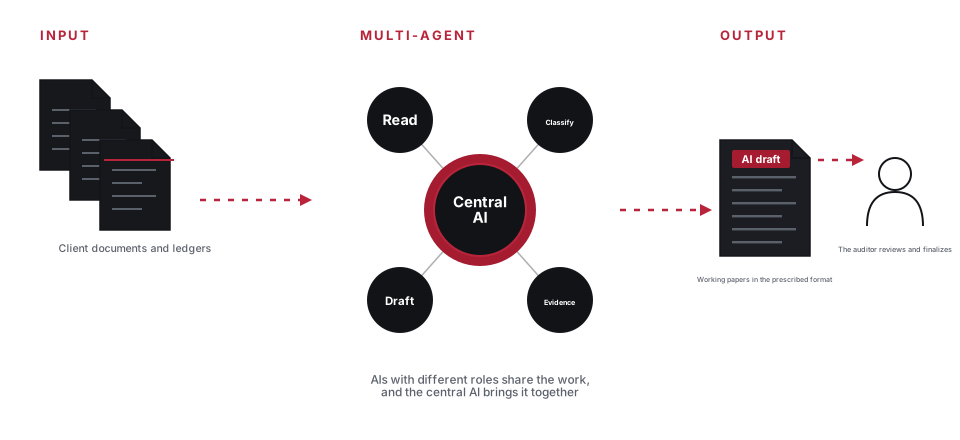
In the work of writing reports, AI handles reading materials, drafting in the required format, and showing the evidence. A central AI coordinates multiple AIs with different roles, handling volumes of materials and formats that a single AI cannot. Passages written by AI are labeled "AI-drafted proposal," and a professional traces them back to the evidence, verifies them, and finalizes them.

Who it is for
Audit and internal audit departments of listed companies, audit firms, law firms, judicial scrivener offices, tax accounting firms, research institutions
What we hand over
A full set of business materials: prescribed forms, supporting documents, ledgers and data, and the Excel files in use
What comes back
Reports and records in the prescribed format (with AI draft markings), and a record of the evidence
The role of people
Review, replacement with the corrected record, and finalization. Each replacement is saved as a new version, so a history of changes is kept

What Is Professional AI
The flow in the first field (audit). Once materials are handed over, AIs with different roles read, classify, draft and keep the evidence. The professional makes the final decision.

Process

Gathers external information, learns the writer's style, writes in a distinctive voice, and revises its own text

  1. Set external information

    You set the external information to reference, such as articles from newspapers and news agencies, and it is imported with sources attached. It also reads prescribed forms, supporting documents, account books, and the Excel files you already use.

  2. Learn the writer

    We add the user's past reports and personality information, and learn each writer's style.

  3. Write in a distinctive style

    Drafts are written in the prescribed format, in wording that reflects the writer's individual style. Passages drafted by AI are clearly marked as "AI draft," and the materials they are based on are recorded.

  4. Corrects itself

    The AI compares the text it drafted against the source materials and corrects any discrepancies on its own. When a professional reviews and replaces text, the updater and the content are kept in the history.

Scale

Volume handled in the PoC and operating records

159 documents

Loaded materials

A total of approx. 68MB across PDF, Excel and Word files, including 15 records of interviews

88 accounts

General ledger

Import all ledgers for each account item

approx. 6,000 characters

Text drafted from a single form

Approx. 15 sheets of 400-character manuscript paper. Drafted 10 types of prescribed forms

219 fields

Entry fields filled in from a single form

Up to the maximum in table-format layouts (grid type)

approx. 7 to 82 seconds

Time required to draft a single form

From Reading Materials to Filling In and Checking

68 cases

Templates drafted in the most recent week

The 7 days through November 6, 2026. This includes operation checks. Drafts that stopped partway number 1 case, and its cause is recorded as an issue.

Every morning

Scheduled automated inspection

AI reviews the working papers that professionals have replaced and looks back over the records of how they were created, then records proposed corrections and issues

9th edition

Versions layered in a single format

AI drafting and professional review and replacement are repeated, and versions and history are retained

Evidence

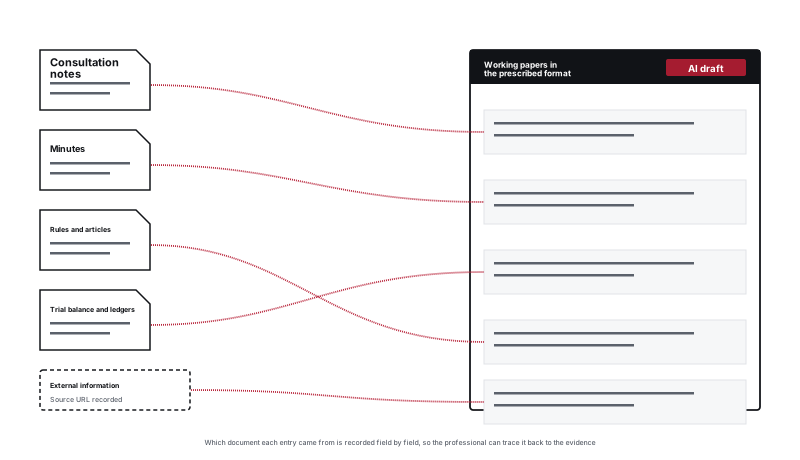
Record the basis for what was written, field by field

AI whose conclusions people cannot trace back to their basis cannot be used in work that carries responsibility. For each draft, we record the materials used, the results and sources of web research, the course of checking and rewriting, and the time taken. Professionals can verify each field by tracing it back to the materials it is based on.

Documents used
The names of the materials used for drafting, such as consultation notes, meeting minutes, regulations and trial balances, and the date each was imported
External information
Search terms, facts found, and source URLs
Progress of the inspection
The record of drafting followed by inspection by a separate AI and rewriting
Fields that stay the same
If the source materials have not been updated, the reviewed version is kept without calling the AI. Confirmed wording is fixed field by field.
Keep the basis for what was written, field by field
Fields in a working paper are linked by lines to their source materials. External information is recorded together with its source URL.

Learning

Corrections made during review are recorded and reflected in the next draft

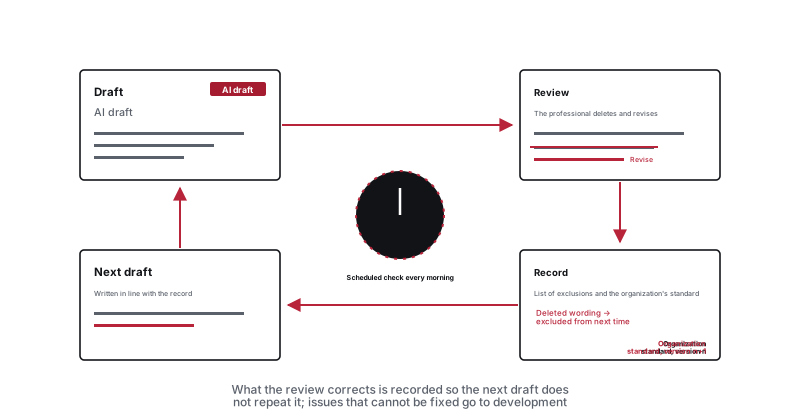
Statements that a professional deletes or revises during review are recorded in an "exclusion list" by topic and by word, and are not used in the next drafting. Revisions decided through consultation on each working paper are finalized as the standard for each organization, and the version is updated. In the scheduled check every morning, AI reviews those working papers replaced by professionals that have not yet been reviewed, and looks back over the creation records. Issues that cannot be resolved by configuring an organization's standard are addressed by our company modifying the system.

List of exclusions
Records the topics, words, and reasons removed during review, so they are not written again in the next draft
Organizational standards
Manages the wording, procedures, and evaluations finalized in review by version, for each organization
Consultation for each working paper
When you ask a question about a working paper, the AI answers and drafts proposed corrections. The professional makes the final decision.
Scheduled inspection
Every morning, it reviews the replaced working papers and looks back over the creation records. Matters that need confirmation are reported in chat.
We record the corrections made in review and reflect them in the next draft.
Drafting → review → record → next drafting. A check is carried out at a fixed time every morning.

Multi-agent

Why build with multi-agent

  1. Separating roles

    We separate the AI that reads, the AI that writes, and the AI that checks, and a central AI passes each one's output to the others for inspection. This handles volumes and formats that a single AI cannot.

  2. Relearns on its own

    Passages deleted or revised during review are recorded so they are not repeated in the next draft. The records are reviewed at set times, and issues that cannot be fixed with standard settings are passed to our development team for modification.

  3. Evidence can be traced

    AI whose conclusions people cannot trace back to their basis cannot be used in work that carries responsibility. We keep a record of which materials each text was written from, so professionals can trace back to the basis.

Features

Screens and functions running on site

Using only a browser, professionals hand over materials, receive working papers, review them, and replace passages.

List of working papers and versions

For each form, the latest version and its status are listed. You can see at a glance which forms are being drafted and which have completed review, and trace the differences between versions.

  • Retrieve the latest version in the prescribed Excel format
  • Saved as a new version each time it is replaced
  • History of who updated and what was changed

Importing Materials

Materials are provided through the screen and managed as supporting evidence. The materials provided are linked to the entries in the working papers as the basis for drafting.

  • Uploading from the screen
  • ZIP files are extracted and imported
  • Show intake status

Format for base data

We receive the figures that form the premise of drafting in a set format. Because they are received in a set format, the premise figures are less likely to be mixed up, and drafting accuracy stays stable.

  • Configuration unit
  • Importance
  • Trial balance

AI drafting

We draft forms by type. Each type has its own writing rules, so the drafts keep the prescribed format and follow the writer's own wording.

  • Descriptive type: fields written in prose
  • Grid type: filling in the fields of a table
  • Transcription type: copying from other records or documents

Consultations and proposed corrections

You ask the AI questions about each working paper and receive proposed corrections. Proposed corrections are applied only after a professional finalizes them.

  • Answers with supporting grounds
  • Adopting or declining proposed corrections
  • Finalization raises the version of the organization's standard

Adding targets

Add a new target (organization and period) from the screen and create it with the same mechanism. Even as the number of targets grows, they can be created with the same mechanism and the same rules.

  • Download the base data format
  • Fill in and upload
  • Keep a standard for each subject

Review

Finalization is done by the professional.

Parts written by AI are labeled "AI draft." A professional traces them back to their basis, checks them, replaces them where needed, and finalizes them.

Case study

In the field of audit, from consultation to productization

  1. —

    Consultation

    An audit firm consulted us about the burden of drafting working papers in the prescribed format, and about staff assignment depending on the experience and intuition of the person in charge.

  2. —

    Documenting requirements

    Organize the prescribed forms by type, confirm the actual state of operations and the requirements in writing through questionnaires, and prepare a feasibility assessment report.

  3. —

    PoC for placement decisions

    We put into operation an agent that decides who to assign to which project, one month after the requirements were finalized. Proof of concept completed (one month of live operation with real data). We compared the AI's decisions with the staff members' decisions for every case, and compiled even the reasons for discrepancies into a report.

  4. —

    PoC for drafting investigation records

    We loaded the client's materials, prepared working papers in the prescribed format using AI and standard documents, and the responsible partner reviewed them. The evaluation: "practically sufficient as a draft to be used while making revisions."

  5. —

    PoC Succeeded; Full-Scale Productization Begins

    The PoC succeeded, and full-scale productization has begun. Contract development has also started. After standardizing the system so that each organization's different formats and approval flows can be matched through settings, we will offer it to professionals in the audit field.

Beyond audit

Following audit, we will expand into legal, tax, internal audit and research.

Reading large volumes of materials and writing reports in a prescribed format is not limited to auditing. We extend the same model to all professionals who produce reports.

Market

The model built in audit, extended to every profession that produces reports

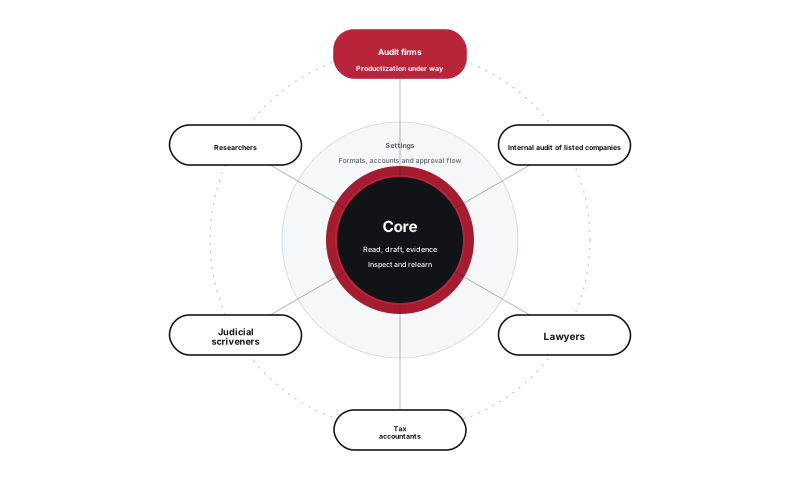
The work pattern of reading, drafting, leaving evidence, and review by a professional is not limited to auditing. The core (the drafting agent itself and the judgment mechanism) is common to all organizations; formats, accounts, and approval flows are adapted through configuration without adding code, and only the parts that truly require individual handling are extended.

Core
Read, draft, leave evidence, check, and relearn. Common to all organizations
Setup
Forms, account items and approval flows. Adapt them without adding code
Expansion
Limited to the scope where individual handling is essential
The model built in audit, extended to every profession that produces reports
The common core stays unchanged; formats and approval flows are matched through configuration.

Users

For all professionals who produce large-scale reports

We complete a working model in audit (read, draft, retain the basis, and have a professional review), then extend the same model to the work of professionals who produce reports.

Audit firms and certified public accountants

Drafts documents from audit working papers through to the audit report. The PoC succeeded in the first field, and full-scale productization has begun. Contract development has also started.

  • Audit working papers and audit reports
  • Audit firms: 301 firms
  • Certified public accountants 37,700

Audit departments and internal audit of listed companies

Drafts internal audit and internal control evaluation documents from your in-house materials. Because links to the supporting materials are kept, the course of the evaluation can be shown later.

  • Internal audit reports and internal control evaluation documents
  • Listed companies: 3,884 companies

Attorneys

It reads contracts and internal documents and compiles the findings into a report. It keeps the correspondence between the materials read and what is written, and final approval is made by a lawyer.

  • Legal due diligence reports
  • Law firms (legal professional corporations): 1,914 firms

Tax accountants

We read ledgers and supporting documents and draft the tax records and documents related to filings. AI handles the transcription and cross-checking of figures first, so tax accountants can spend their time on judgment.

  • Tax records and filing-related documents
  • Tax accounting firms 5,346 firms

Judicial scrivener

Reads registration and asset management materials and drafts documents and reports in the prescribed formats. It drafts according to the prescribed format, and a judicial scrivener finalizes them.

  • Registration application documents
  • Property management reports

Researchers and research institutions

We read across literature and data and compile research reports while keeping the sources. Because the sources are kept, the basis for each statement can be traced at any time.

  • Research report
  • Research report

Context

Operations

Professional staff generate, review and replace working papers in the browser. Passages drafted by AI are clearly marked as "AI draft," and final decisions are always made by a professional. AI is limited to interpreting materials and drafting text; the judgment formulas and forms are fixed.

Case study

Case Study

We present the flow and the finished form in the form of reports. Each one states clearly whether it is based on our actual operations or is an example assumed from how such work is normally done.

Draft audit working papers in the prescribed format.
Example based on our own operating experience

Audit

Drafting audit working papers
in the prescribed format.

This is an example of our products. In audit work, AI did the groundwork of reading materials and preparing working papers in the prescribed format, and professionals finalized them.

  1. Import the materials and manage them as evidence
  2. Draft forms by type
  3. Check against the materials and correct itself
  4. A professional reviews and finalizes

ReportReport for this case

Flow
Run this cycle: intake → drafting → self-check → review and finalization. The PoC succeeded, and full-scale productization has begun.
Deliverables
  • Drafting in the prescribed format
  • Linking to source documents
  • Review records
Points to confirm
  • Whether any statements lack supporting evidence
  • Is it getting closer to the writer's text?
  • Whether finalization is done by the professional
Drafts the contract due diligence report clause by clause.
Example based on typical ways of working

Legal affairs

Drafts the contract investigation report
clause by clause.

At a law firm, reading many contracts and compiling the results of clause-by-clause research into reports takes a great deal of time.

  1. Import contracts and manage them as the basis for answers
  2. Decide the clauses to check and the criteria
  3. AI drafts, pointing to the relevant passages
  4. A lawyer verifies and finalizes

ReportReport for this case

Flow
Proceed in this order: intake → criteria → drafting → finalization.
Deliverables
  • A list of the relevant passages for each clause
  • Report drafting
  • Linking to source documents
Points to confirm
  • Whether anything has been overlooked
  • Whether any statements lack supporting evidence
  • Whether finalization is done by the attorney
We read across literature and data and produce research reports with cited sources.
Example based on typical ways of working

Research

We read across literature and data
and produce research reports with cited sources.

At a research institution, staff are swamped with reading many papers and datasets and compiling survey reports while keeping the sources intact.

  1. Import the literature and data
  2. Decide the questions to investigate and the reporting format
  3. AI drafts with sources attached
  4. A researcher verifies and finalizes it

ReportReport for this case

Flow
Proceed in this order: intake → defining the questions → drafting → finalization.
Deliverables
  • Drafting research reports with cited sources
  • Correspondence between literature and data
  • Record of finalization
Points to confirm
  • Whether sources can be traced
  • Whether anything not in the literature has been written
  • Whether finalization is done by the researcher

Operating scale — from system logs

AI that carries the work of thousands of people,
operated every day in our own business.

At the foundation of our products is AI that we run every day in our own businesses.

approx. 100,000cases/day

Checks bid notices published by government agencies and others 4 times every day, with AI judging deadlines, participation conditions, and fit with our company

1,108cases

Bidding projects whose deadlines and progress are managed by AI

4,084items

Orders, inventory, pricing, advertising, and finance on one platform

86functions

In-house system functions that can be run directly from AI assistants

8systems

AI systems we actually run in our own business

Values retrieved from each system's records (as of November 9, 2026). "Thousands of people" is a figure we calculated: we converted this workload into the effort it would take people to process it with the same tasks, and took the number of people needed to finish it within twenty-four hours. It is not a measurement by a third party.

View the workload breakdown

Contact

For professionals who prepare reports and corporate internal audit departments

We accept requests for explanations and demos. Please tell us the formats and types of documents you use.

Request an Explanation or Demo